For filmmakers, a wide angle cine lens expands the field of view, enables dramatic space, and supports creative depth of field control. This guide highlights five standout options across different mounts and price points, focusing on image quality, construction, and usability in low light. Each lens is evaluated for landscape and architectural work, interior scenes, and immersive storytelling. Use this overview to compare how close-focus performance, aperture, and build influence your shot decisions on set.
| Lens | Brand | Mount/Compatibility | Max Aperture | Notable Strength |
|---|---|---|---|---|
| SIRUI Night Walker 16mm | Sirui | Canon/ Sony E | T1.2 | Ultra-wide for expansive scenes; strong low light |
| Rokinon 14mm F2.8 (Canon EF) | Rokinon | Canon EF | F2.8 | Ultra-wide perspective; versatile for interiors |
| Rokinon 14mm T3.1 Cine DS | Rokinon | Canon EF | T3.1 | Cine-grade with de-clickable aperture |
| Rokinon 21mm / 14mm options | Irix | Canon EF | T1.5 | Robust optics; weather sealing |
| 7Artisans 12mm T2.9 | 7artisans | Sony E | T2.9 | Wide field, close focus, compact build |
Note: The products listed are representative wide-angle cine lenses with manual or cinema-grade features suitable for independent and professional productions. Availability, mounts, and compatibility vary by camera body. Always verify current fit for your camera system before purchasing.
SIRUI Night Walker 16mm Cine Lens

The SIRUI Night Walker 16mm is a compact wide-angle option designed for E-mount cameras including FX30 and Sony APS-C models. It features a 16mm focal length that broadens situational framing for landscapes and architectural shots. The lens opens to a bright T1.2, enabling strong depth-of-field control and improved performance in low light, with a close focusing distance of 0.3 meters for macro-style detail work. Its manual focus design provides tactile control ideal for precise, cinematic movements.
Rokinon 20mm T1.9 Cine DS AS ED UMC

The Rokinon 20mm T1.9 Cine DS lens delivers a cinematic wide angle with a usable working distance on Canon EF bodies. It combines DS-level color consistency with a unified gear system across DS lenses, facilitating smooth manual control of focus, iris, and focus pulling during shoots. The wide 20mm field of view is well-suited for environmental portraits, interiors, and immersive exteriors, while the T1.9 aperture supports low light work with pleasing bokeh when stopped down for dialogue scenes.
Rokinon 14mm F2.8 IF ED Super Wide Angle

The Rokinon 14mm F2.8 is a classic ultra-wide option for Canon EF with an approximately 90-degree angle of view on APS-C and broader perspective on full-frame bodies. Its minimum focusing distance around 28 cm enables expressive close-ups within expansive scenes. A built-in petal-type hood helps reduce flare in bright environments. The lens balances weight and performance for architectural shoots, interiors, and dramatic landscape work, offering visual impact with edge-to-edge sharpness at wider apertures.
Rokinon 35mm T1.5 Cine DS

The Rokinon 35mm T1.5 Cine DS offers full-frame coverage with a cine-focused T-stop range and DS color matching. Its 63.1-degree field of view on full-frame bodies and unified gear positions help streamline production workflows. This lens is well-suited for medium-shot compositions, controlled depth of field, and versatile storytelling when a slightly longer perspective is preferred over ultra-wide capture.
Rokinon 14mm T3.1 Cine DS
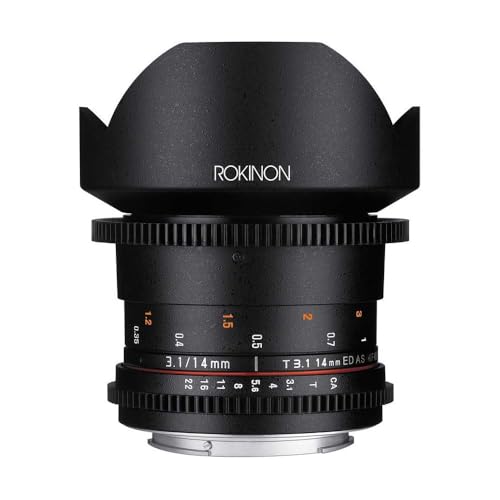
The Rokinon 14mm T3.1 Cine DS is designed for cinematic applications with a true cinema aperture range and a generous ultra-wide perspective. The 115.7-degree angle of view supports sweeping landscapes, large interiors, and immersive establishing shots. Its DS line features color matching and repeatable settings across lenses, enabling consistent on-set looks when dialing in lighting and exposure for group scenes or wide establishing takes.
Irix Cine 21mm T1.5 Wide Angle

The Irix Cine 21mm T1.5 is a robust, weather-sealed option with military-grade certification for humidity and freezing rain. It emphasizes sharpness, color fidelity, and distortion control across the entire lens set. Engraved markings with UV-reflective paint aid low-light operation, making it useful for exterior shoots at night or in poorly lit locations where accurate focus and exposure are critical. It suits documentary and narrative projects requiring durable glass with consistent performance.
Buying Guide: Key Purchase Considerations
- Camera system compatibility: Confirm mount Type (EF, E-mount, etc.) and whether the lens supports full-frame or APS-C factors to maintain the desired field of view on your camera body.
- Cinematic features: Look for de-clickable aperture, T-stop accuracy, and a cine-style focus and iris gearing system for smooth rack focusing and consistent exposure control during takes.
- Aperture and low-light performance: Brighter maximum apertures (low f-number or low T-stop) improve performance in dim sets and night exteriors, enabling exploratory storytelling with shallow depth of field when required.
- Optical design and distortion: Ultra-wide lenses can exhibit distortion; evaluate the lens at the edges to ensure the intended look remains natural or suits your effect goals. Weather sealing adds durability for outdoor shoots.
- Close-focus capability: A short minimum focusing distance expands possibilities for macro-like detail shots and more intimate framing within wide compositions.
- Build quality and weight: Consider handle comfort, balance with your rig, and whether the lens balance fits your gimbal or shoulder rig for steady movement.
- Color and consistency: Cine DS and similar lines aim for color matching across multiple lenses, simplifying grading and cross-lens shoots in a project.
- Budget and value: While ultra-wide cinema lenses can be costly, prioritize features that directly affect your typical shooting scenarios, such as close focus or de-click capability, to maximize return on investment.
- Future-proofing: If you plan to expand to other mounts, opt for lenses with broad compatibility or modular designs that can be adapted with adapters without compromising optics.