Choosing the right USB camera module can boost performance in robotics, computer vision, and DIY video projects. The following five options represent a range of megapixel capabilities, from 2MP to 12MP, and include features like autofocus, global shutters, and high frame rates. Each entry is selected for compatibility with Windows, Linux, Mac OS, and common single-board computers. Use this guide to compare image quality, speed, lens options, and ease of integration for your next project.
| Product | Brand | Key Feature | Resolution / Frame Rate |
|---|---|---|---|
| Arducam 1080P Day & Night USB Camera | Arducam | Auto IR-Cut, 2MP sensor | 1920×1080 @ 30fps |
| Arducam 100fps Mono Global Shutter USB Camera | Arducam | Global Shutter, IR-sensitive | 1MP @ up to 100fps |
| IFWATER 16MP USB Camera | IFWATER | High-resolution 16MP, varifocal lens | up to 4656×3496 |
| Arducam 4K 8MP IMX219 Autofocus | Arducam | Autofocus, 8MP sensor | 1080P / 3264×2448 |
| ELP 720p Wide Angle USB Camera Module | ELP | Wide angle, no distortion | 720P @ 30fps |
Each product below is linked for quick viewing on Amazon and includes a representative image to help you compare form factors and mounting options. The features listed reflect the official product descriptions and specifications provided by the sellers.
Arducam Day & Night USB Camera — 2MP with IR LEDs

This USB camera module uses a 2MP OV2710 sensor to deliver crisp video with a maximum resolution of 1920×1080 at 30fps. The Day/Night feature automatically switches the IR-CUT filter to optimize image quality in varying light. With 850 IR LEDs for enhanced night vision, it remains practical for surveillance or machine-vision tasks in low light. The camera communicates over USB 2.0, ensuring broad compatibility with Windows, Linux, Android, and Mac OS environments. A built-in IR sensitivity helps capture clearer footage in darkness while preserving daylight color accuracy.
Key points: automatic IR-cut switching, full HD 1080p at 30fps, flexible operating system support, and robust low-light performance. The module’s compact footprint makes it suitable for desktop setups or embedded projects that require a stable, plug-and-play webcam solution.
Arducam 100fps Mono Global Shutter USB Camera

Built around the OV9281 monochrome global shutter sensor, this camera delivers high-speed capture with minimal motion artifacts. The 70-degree low-distortion M12 lens is IR-sensitive and includes reserved external trigger ports for external signaling. Resolution sits at 1MP (1280×800), with MJPG up to 100fps and YUY2 at multiple lower resolutions. The global shutter makes it an attractive choice for fast-moving scenes or machine-vision systems requiring precise frame capture without rolling shutter distortion.
Consider its external trigger support for synchronized multi-camera setups and the emphasis on IR-sensitive imaging. It’s well-suited for robotics or high-speed inspection tasks where latency and artifact reduction are critical.
IFWATER 16MP USB Camera With Varifocal Lens

This high-resolution IFWATER camera leverages a 16MP IMX298 sensor to capture highly detailed images up to 4656×3496. The 5-50mm manual varifocal lens provides flexible field-of-view control, enabling precise framing for close-up or wide-angle shots. USB 2.0 plug-and-play compatibility minimizes setup time across Windows, Linux, Mac OS, and Android. The robust build and camera’s versatility make it a strong candidate for industrial imaging, surveillance, and research projects that demand high image fidelity and adjustable optics.
Strengths include true optical adjustability, high still-image resolution, and straightforward software integration. This model emphasizes image quality and control over field-of-view rather than mere video throughput.
Arducam 4K 8MP IMX219 Autofocus USB Camera
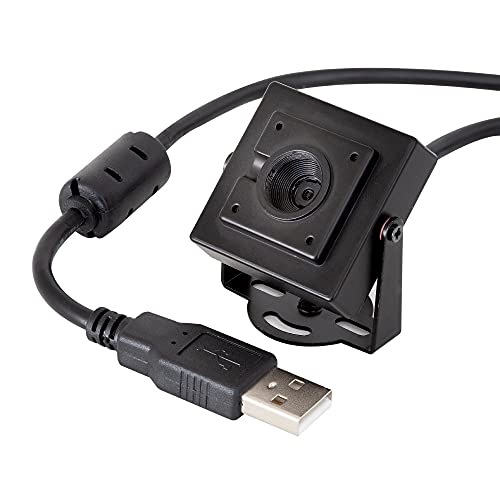
This model packs an 8MP IMX219 sensor with autofocus, enabling sharp imagery across a range of distances without manual lens adjustments. It outputs video up to 1080p/720p at 30fps and supports MJPG/YUY2 formats for flexible streaming. A built-in microphone allows capturing audio alongside video, which can be advantageous for conferencing or commentary in vision-enabled applications. The high-resolution stills reach 3264×2448, enabling post-processing or archival-quality capture in addition to live video.
Autofocus simplifies setup for dynamic scenes, and the mic adds value for integrated systems that require audio capture. Consider this option when you need detailed imagery and distance-aware focusing in a single compact module.
ELP USB Camera Module With Wide 100° Lens

ELP’s compact camera module features a 100-degree M7 wide-angle lens designed for broad field coverage. It delivers up to 1280×720 at 30fps, with high pixel quality to preserve color accuracy and sharpness across the frame. The UVC-compatible USB 2.0 interface makes it easy to connect to PCs, laptops, and embedded devices. Its small footprint supports discreet installation in projects ranging from smart devices to hidden surveillance or monitoring rigs.
Choosing this module is advantageous when you need wide-area visibility in tight spaces without sacrificing too much resolution at 720p. It’s a practical balance between field of view and simplicity of integration.
Buying Guide: Key Purchase Considerations
- Resolution vs. frame rate: Higher megapixels can improve image detail, but may reduce real-time frame rates on lower-end hardware. Consider your target processor and memory constraints when selecting a camera for real-time Vision or AI tasks.
- Sensor type and global shutters: Global shutter sensors reduce rolling shutter artifacts on fast-moving subjects, which is critical for robotics and high-speed inspection. Monochrome sensors can offer improved sensitivity in infrared environments, while color sensors deliver richer scenes in daylight.
- Lens options and optics: Varifocal or fixed-focus lenses affect framing flexibility and setup time. Wide-angle lenses expand coverage but may introduce distortion if not corrected in software.
- Low-light and IR capability: Cameras with IR illumination or infrared sensitivity are beneficial for night-time or low-light scenarios. Automatic IR-Cut switching helps maintain color accuracy during daytime.
- Interface and compatibility: USB 2.0 is widely supported, but consider USB-C or higher bandwidth connections if you plan 4K or high-frame-rate capture. Ensure OS compatibility with Windows, Linux, and Mac environments, as well as driver-free operation where possible.
- Physical form factor and mounting: Small, lightweight modules suit embedded projects, while larger boards may offer easier handling and debugging. Check mounting holes, connector types, and cable length for your setup.
- Audio capabilities: Some modules include built-in microphones, which can add value for conferencing or multimedia projects but may not be essential for pure imaging tasks.
- Price-to-performance balance: Higher-resolution and faster cameras often come at a premium. Align features with the project requirements to avoid overpaying for capabilities not needed.
- Software and developer support: Look for SDKs, sample code, and community forums. Rich documentation accelerates integration with OpenCV, ROS, or other machine-vision frameworks.
- Power and cabling: Confirm power requirements and cable length to prevent under-powering cameras in extended rigs. Some USB cameras draw power from the USB port, while other setups may require external power.
These considerations help balance image quality, speed, and integration ease. When selecting a USB camera module for American projects, prioritize compatibility with your software stack (such as OpenCV or ROS), required resolution, and the environmental conditions in which the camera will operate. The five products listed offer varied strengths—from high-resolution stills and autofocus to global shutter speed and wide-angle coverage—allowing you to tailor a choice to your application, budget, and hardware platform.