Overhead shooting unlocks creative perspectives for product photography, cooking videos, tutorials, and live streams. A sturdy overhead tripod or arm minimizes shake, supports camera gear at precise heights, and offers flexible angles. Below are five proven options that blend stability, reach, and ease of use for overhead video and photography. Each product is evaluated for load capacity, height flexibility, and arm or center-column design to help you choose the best fit for your setup.
| Product | Brand | Max Load / Weight | Height / Reach |
|---|---|---|---|
| NEEWER 72 Inch Camera Tripod Monopod | NEEWER | 33 lb / 15 kg | Up to 72 inches |
| K&F CONCEPT 90” Tripod | K&F CONCEPT | 10 kg | Up to 90 inches / 2.3 m |
| SmallRig CT200 Horizontal Overhead Tripod | SMALLRIG | 33 lb / 15 kg | Up to 200 cm as main unit; 140 cm as monopod |
| SmallRig CT25 Horizontal Overhead Tripod | SMALLRIG | 22 lb | Up to 64.5 inches |
| ZIKZOK 70″ Overhead Phone Tripod | ZIKZOK | Phone-based load (lighter gear) | Up to 70 inches |
The following sections highlight five headlining options, each with a compact image, quick access to the Amazon listing, and a summary of key features that influence overhead performance. This selection balances high reach, stability, and usability for overhead shots with cameras or smartphones.
NEEWER 72 Inch Tripod With Center Column And Ball Head
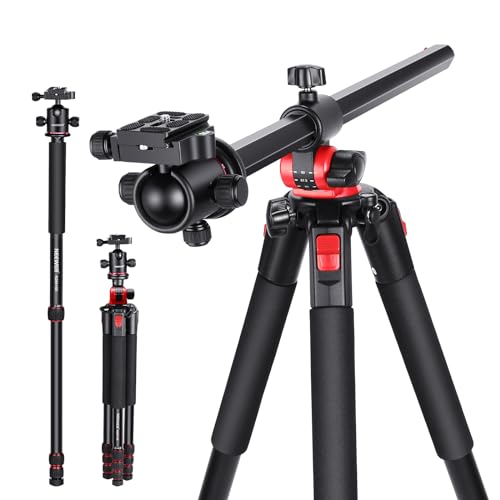
The NEEWER 72 Inch tripod uses an aluminum alloy frame with a robust 28 mm tube diameter to support gear up to 33 lb (15 kg). It includes a center-column design that supports vertical and horizontal shooting angles (0°, 22.5°, 45°, 67.5°, 90°, plus 360° panning). A reversible center column enables macro-focused overhead shots, while a 3-knob panoramic ball head and Arca-type quick-release plate simplify quick composition changes. Two bubble levels help keep framing straight. Optional ballast via a carabiner-ready loop increases stability for windy or uneven spaces.
K&F CONCEPT 90” Ultra High Camera Tripod

The K&F CONCEPT model reaches up to 90 inches (2.3 m), giving expansive overhead coverage. It features a patent gimbal for 0–120° tilting and 360° rotation, enabling versatile overhead angles. The four-section legs collapse to a compact size for transport, and the heavy base is designed to minimize camera shake. A notable 28 mm center column diameter contributes to vertical stability when the arm is extended horizontally, helping maintain sharp overhead footage for longer takes.
SmallRig CT200 72.8″/200 cm Horizontal Overhead Tripod

The SmallRig CT200 offers a horizontally oriented center column with 180° tilt and 360° horizontal rotation for panoramic overhead shots. It converts to a monopod for flexible shooting and provides a wide height range from 26 cm to 185 cm (10.2 to 72.8 inches) as a tripod, with a maximum working height of 140 cm as a monopod. Quick-lever leg locks and 29 mm tubes provide solid stability with a stated load of up to 33 lb (15 kg) for equipment compatibility. This model emphasizes stable overhead performance with a modular design for dynamic shoots.
SmallRig CT25 64.5″/164 cm Horizontal Overhead Tripod

The CT25 provides a maximum height of 64.5 inches and a 22 lb load rating, making it suitable for lighter overhead tasks or dual-device setups with a smartphone and compact camera. It emphasizes stability through thickened aluminum legs and a 360° ball head, enabling shake-free horizontal positioning for overhead shots, live streaming, and product photography from above.
ZIKZOK 70″ Phone Tripod And Overhead Arm

With a 70-inch reach and a lightweight aluminum build, this overhead setup combines a phone holder with a long horizontal boom. It includes a 1/4-inch screw compatibility and a horizontal column that enables multi-device mounting options for overhead filming. The design suits mobile creators focusing on overhead cooking, crafts, and tutorials, offering a balance between reach, stability, and portability for on-the-go shoots.
Buying Guide: Key Purchase Considerations And Comparisons
- Height and reach: Overhead shots benefit from tall legs and extended arms. Choose models offering at least 70 inches of reach when possible, or a horizontal arm that can sweep above a work surface.
- Center column design: Vertical center columns help with height, while horizontal or flip-center designs enable true overhead angles. Some models offer 180° or 360° rotation for flexible framing.
- Load capacity: Match the maximum load to your camera body, lens, and any accessories like external monitors or lights. Heavier rigs require sturdier tripods (33 lb / 15 kg or more).
- Stability features: Look for thick-walled tubes, robust tripod feet, and ballast options (sandbags or weighted bases) especially in windy or uneven environments.
- Portability and setup: Consider whether you need a monopod option, quick-lever leg locks, and a compact folded size for travel or on-location shoots.
- Compatibility: If you use smartphones, verify phone-holder compatibility and the presence of 1/4″-20 mounting threads for accessories like clamps, lights, or gimbals.
- Versatility: Some models convert to monopods or offer dual-device mounting, which can expand use-cases from overhead cooking to product photography and live streaming.
- Build quality: Aluminum construction is common, but check for solid joints, smooth pan/tilt controls, and reliable quick-release plates to minimize drift during long takes.
- Price-to-value: Higher reach and load capacities typically increase cost. Prioritize stability and flexibility aligned with your most frequent overhead use cases.
When selecting an overhead tripod system, align the choice with your typical work context: high-precision product shots may favor taller, heavier duty systems; cooking or art tutorials may benefit from lightweight, easily adjustable arms; and mobility-focused creators might prefer a monopod-capable design with quick setup.