Choosing a tripod that confidently supports heavy camera setups requires attention to load capacity, height range, stability features, and portability. The following selections are among the top options for professional or enthusiast use in America, balancing rugged build quality with practical features like 1/4″ screws, 360-degree heads, and easy folding. This guide highlights five models well-suited for long lenses, DSLR setups, and occasional spotting scopes, with concise product sections to help you compare quickly.
Summary of Selected Products
| Product | Brand | Max Load | Max Height |
|---|---|---|---|
| VICTIV 74” Camera Tripod | Victiv | 9.5 lb | 74 inches |
| K&F CONCEPT 64 inch DSLR Tripod | K&F CONCEPT | 17.6 lb | 64 inches |
| JOILCAN 74” Tripod For Camera | JOILCAN | 15 lb | 74 inches |
| K&F CONCEPT 90” Ultra High Tripod | K&F CONCEPT | 10 kg | 90 inches |
| NEEWER 79″/200cm Video Tripod | NEEWER | 8 kg | 79 inches |
VICTIV 74” Camera Tripod

The VICTIV 74” Camera Tripod provides a tall stance with a 19–74 inch height range, suitable for ground-level to elevated shots. It weighs about 3.14 lb (1.4 kg) and ships with a carrying bag for portable use. Its 1/4″ screw mount fits Canon, Nikon, and other DSLR or mirrorless cameras, as well as spotting scopes and compact camcorders. A 3-way pan head enables smooth horizontal panning, vertical tilting, and portrait framing. The solid aluminum construction offers reliable stability and a weight hook adds extra ballast for windy or uneven surfaces. This model primarily targets everyday professionals needing versatility in a lightweight package.
Key features: 74″ max height, 9.5 lb load capacity, 3-way pan head, phone mount compatibility, lightweight aluminum build
K&F CONCEPT 64 inch DSLR Tripod

The K&F CONCEPT 64 inch tripod emphasizes portability with a folded length around 15.5 inches and a light overall weight of about 2.53 lb (1.15 kg). It features a 360-degree ball head for precise panoramas and long-exposure shots, supporting up to 17.6 lb (8 kg). The design includes quick-flip leg locks for fast setup and a compact carrying bag. Its solid aluminum construction offers robust stability while remaining travel-friendly for field work or outdoor shoots, making it a strong choice for travelers and hobbyists who still require dependable load capacity.
Key features: 64″ max height, 17.6 lb capacity, 360° ball head, quick-flip leg locks, light and portable
JOILCAN 74” Tripod For Camera
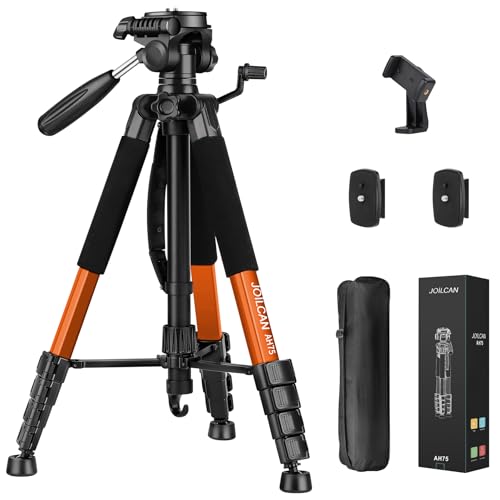
JOILCAN’s 74″ tripod is designed for heavy-duty use with a claimed load up to 15 lb. It balances height and portability with an 18″ compact footprint and a weight around 3.15 lb. Features include quick-release plates, a universal 1/4″ screw, and a phone holder, broadening compatibility to include cameras, smartphones, webcams, and light projectors. The build emphasizes durability with thicker tubing to resist torsional twisting and strong rubber feet for stable footing on varied terrains. This model suits travelers and event shooters who need reliable setup time and versatility in a single unit.
Key features: 74″ height, 15 lb capacity, lightweight aluminum, quick-release, phone holder
K&F CONCEPT 90” Ultra High Tripod

The K&F CONCEPT 90” Ultra High Tripod targets elevated shooting with a maximum reach of 90 inches. It offers a detachable monopod option, a 28mm diameter center column for added stability, and a patent gimbal-style head for versatile angles (0–120° tilt and 360° pan). The collapsed length measures about 54 cm, helping with transport, while the four-section legs balance height and portability. It supports up to 10 kg of gear, making it suitable for longer telephoto setups, studio work outdoors, and video shoots where overhead angles or tall frames are essential.
Key features: 90″ max height, 28mm center column, detachable monopod, 360° pan, 10 kg capacity
SMALLRIG 71″ Tripod/Monopod

SMALLRIG’s 71″ foldable tripod offers 360° ball head rotation and a detachable monopod feature, combining two functions in one unit. It supports a payload up to 33 lb and offers height flexibility from 16″ to 71″. The 36mm ball head allows precise angle adjustments, including macro or low-angle shots, and the design emphasizes compatibility with 1/4″ and 3/8″ threaded devices. This model is well-suited for professionals needing a versatile rig for both still photography and video work, with a focus on stability and adaptability in field conditions.
Key features: 71″ height, 33 lb payload, 2-in-1 tripod/monopod, 360° ball head, versatile compatibility
Buying Guide: Key Purchase Considerations
- Load capacity vs. gear weight: Choose a tripod with a rated load that comfortably exceeds your heaviest camera body plus lens. For long telephotos, a buffer of 20–50% beyond your expected load improves stability in wind and on uneven ground.
- Height range and stability: A higher maximum height is helpful for overhead shots, but stability often improves with a wider base and leg spread. Look for models with sturdy leg locks, rubber feet, and a weight hook.
- Head type and maneuverability: 3-way pan heads deliver precise framing ideal for landscapes and architectural shots, while ball heads offer quick adjustments. Consider 360-degree rotation for panoramas and 90-degree tilting for vertical compositions.
- Portability vs. durability: Tripods range from ultralight alloys to heavier alloy builds. If you travel frequently, prioritize compact folded length, but ensure the legs and joints can endure frequent setup and takedown.
- Versatility features: Quick-release plates, smartphone mounts, monopod conversion, and detachable heads add workflow flexibility. Ensure compatibility with your existing gear (1/4″ and 3/8″ screw standards).
- Materials and construction: Aluminum is common and affordable; carbon fiber offers lighter weight and vibration damping at a higher cost. For heavy loads, robust aluminum with reinforced joints is often sufficient.
- Included accessories: Carry bags, leg wedges, extra quick-release plates, and user manuals influence setup speed and transport convenience. Always check what is included to avoid additional purchases.
When selecting a tripod for heavy cameras, prioritize stability, load capacity, and height flexibility. Consider whether you need a monopod option, quick setup features, or extra accessories for field versatility. The models listed balance these aspects to serve diverse needs—from wildlife or sports photography to studio-like outdoor shoots with long lenses.