When choosing a trail camera, some models emphasize wireless transfer and built‑in storage to minimize handling SD cards in the field. This guide highlights five trail cameras that emphasize app-based viewing, direct phone transfers, or internal storage features that reduce the need to retrieve a memory card. Each entry draws on user-friendly wireless capabilities, long battery life, and rugged design suitable for outdoor scouting, wildlife monitoring, or home security. The following sections summarize key features and include a quick reference to help you compare options at a glance.
Summary Of Selected Models
| Product | Brand | Wireless/Storage Highlights |
|---|---|---|
| MAXDONE Trail Camera | MAXDONE | App transfer via TrailCamGO; Detachable solar panel; 6000mAh battery |
| WOSPORTS 48MP WiFi Trail Camera | WOSPORTS | WiFi with phone app; solar option; 7800mAh battery |
| DEATTI Trail Camera 48MP 4K | DEATTI | WiFi hotspot; remote mobile app access; 2160P/48MP |
| WOSODA 2 Pack Trail Cameras | WOSODA | Night vision; solar charging option; SD card included in package (note: for secondary data backup) |
| KJK Trail Cameras 36MP 2.7K | KJK | Built‑in infrared and hotspot features; 0.1s trigger |
Note: While several models listed include SD cards in their bundles or rely on removable storage for local backups, many also support direct app-based viewing or hotspot access, which reduces the immediate need to remove memory cards during routine checks. Review the product pages for specifics on storage options and transfer methods before purchasing.
MAXDONE Trail Camera With Solar Power And App Transfer

The MAXDONE trail camera combines a high-resolution 4K video capture with 64MP stills and a long‑lasting 6000mAh rechargeable battery. A detachable solar panel supports sun-facing charging to extend field use. When paired with the TrailCamGO app via WiFi and Bluetooth, users can view and send photos and videos directly to a phone without removing the SD card from the unit, within a practical 10–55 ft range. The camera is designed for harsh outdoor environments with IP66 weather resistance and a wide 130° field of view, making it suitable for wildlife monitoring, scouting, and home security.
Key features include the detachable solar panel with manual tilt, three charging modes (solar, Type-C, battery), and app-based transfers, reducing on-site SD card handling. The camera acts as its own hotspot, which means it does not rely on home Wi‑Fi or network access. This design makes it a compelling option for remote locations where power and network access are limited.
Potential considerations: While app transfers reduce the need to retrieve the SD card, some users may still add an SD card for extended local storage. Battery management and solar exposure in shaded environments can affect performance, so plan for consistent sun exposure on the panel where possible.
WOSPORTS 48MP WiFi Trail Camera With Solar Power
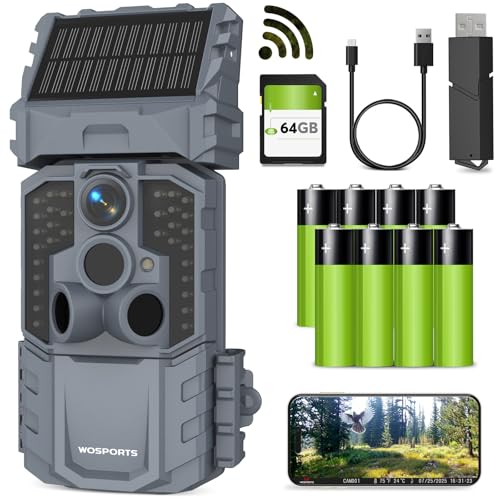
The WOSPORTS 48MP WiFi Trail Camera delivers a high-resolution still image experience with 2K MP4 video and a built‑in 7800mAh solar-charged battery. Its standout feature is a stable Wi‑Fi connection and a dedicated app that facilitates direct transfers to a phone. It operates without relying on home Wi‑Fi networks, positioning it well for field use where you want quick access to captured footage without frequent SD card retrieval. The 120‑degree lens adds a wide viewing angle, making it suitable for perimeter security or wide-area wildlife surveys.
Considerations include the need to stay within the app’s connectivity range and the potential limitation of not supporting home Wi‑Fi connections. Solar charging helps, but optimal performance comes from consistent sun exposure. The model emphasizes long-term operation with less manual maintenance and straightforward on-site viewing via the app.
DEATTI Trail Camera 48MP 4K With WiFi Hotspot

DEATTI’s 48MP/4K trail camera is mounted on WiFi hotspot technology, enabling remote access via a mobile app. The device supports high-resolution stills and 4K video, designed for wildlife observation and security monitoring in outdoor settings. The hotspot approach means you can check footage and status without routinely removing an SD card, though typical field setups may still include an SD card for local backup. The camera is described as rugged and waterproof, suitable for wildlife, deer monitoring, or security at remote properties.
Important notes: The model emphasizes remote connectivity and does not rely on home Wi‑Fi. It’s best used where a smartphone within proximity can maintain a direct link to the hotspot. The inclusion of Bluetooth/WiFi for remote access makes it a practical option for users who prefer periodic, phone-first checks over card pulls.
WOSODA 2 Pack Trail Cameras With Night Vision

This two-pack from WOSODA emphasizes night vision and motion activation with 30MP still images and 1080P video. While the package includes memory cards, the cameras are designed for extended field use with night-vision efficiency and a long trigger range. The dual-pack setup makes it convenient for simultaneous monitoring of two zones, and solar charging is a potential option for extended field deployments. The infrared LEDs provide lower glow night vision, preserving a natural nocturnal environment for wildlife monitoring.
Considerations include whether you’ll rely on the included SD cards or prefer app-based viewing. In practice, you may pair this with an optional SD card for local backup while using the cameras’ wireless transfer features to view footage on a mobile device in the field, reducing the need to handle cards frequently.
WOSPORTS Mini Trail Camera

The WOSPORTS Mini Trail Camera is a compact, high-resolution option with 36MP stills and 1440P video. It emphasizes fast 0.2s trigger time and a 120° wide angle for wider field coverage. It’s designed to be a portable option for quick field checks or backpack scouting. The product includes a micro card reader feature that helps you quickly view captured data on a computer, which can be convenient when you want to review footage without removing the SD card from the camera itself. The small form factor makes it easier to deploy discreetly in multiple locations.
For users prioritizing portability and quick checks, the camera’s balance between image quality and ease of transfer makes it a compelling option. If you rely heavily on smartphone transfers, verify the transfer range and app compatibility with your device before purchase.
KJK 2 Pack Trail Cameras With Fast Trigger

The KJK two-pack focuses on high-speed triggering and a broad 130° detection range, helping capture quick wildlife movements in expansive areas. The 36MP stills and 2.7K video offer crisp visuals, and the 22Pcs 850nm low glow LEDs support night captures with reduced disturbance to animals. The product highlights include a 2.0″ HD TFT color screen for viewing footage on-site, which is useful when you want a quick check without pulling the SD card. This model is well-suited for wildlife monitoring, farm security, and property surveillance in moderate to harsh outdoor conditions.
Considerations include whether you’ll rely on the built-in LCD for on-site viewing and the extent to which you can leverage hotspot features for remote viewing. If you are aiming to minimize SD card handling, pairing with a compatible app or hotspot workflow can help reduce field downtime.
Buying Guide: Key Purchase Considerations
Wireless Access And Transfer Options
Look for cameras offering direct app support or hotspot-enabled access to view and transfer footage without removing the SD card. Confirm the effective range for transfers and whether the device creates its own hotspot or relies on nearby networks.
Battery Life And Power Options
Consider solar charging capability, battery capacity (mAh), and charging modes. Solar panels that adjust to sun angle and seasonal light can extend field life in remote locations. If solar is not viable, check battery type and replacement ease for longer deployments.
Image And Video Quality
Assess resolution (MP for photos and K for video) and frame rate. Higher resolutions improve detail but may require more storage if you do use memory cards. For apps-based viewing, ensure file formats align with your phone and software ecosystem.
Trigger Speed And Detection Range
Fast 0.1–0.3 second triggers help minimize missed moments. A wide detection angle (100–130 degrees) broadens coverage and reduces blind spots. Decide which combination best suits your monitoring scenario—wide open spaces vs. narrow corridors.
Durability And Weather Resistance
IP ratings like IP66 are common for outdoor use, ensuring resistance to rain and dust. Consider mounting options and the camera’s ability to operate in extremes of temperature and humidity.
Storage Flexibility
Even models marketed as “no SD card” or “no need to remove SD” may still benefit from an SD option for local backups or extended storage. If your aim is minimal SD card handling, prioritize models with robust wireless transfer and sufficient internal or cloud-like storage options, if available, and verify any cloud features or app-based archives.
By evaluating these factors—wireless transfer capabilities, power options, image quality, trigger performance, weatherproofing, and storage flexibility—you can select a trail camera that better aligns with a no-fuss field workflow while still delivering reliable wildlife and security monitoring.