Finding an entry-level trail camera that’s easy to use, reliable, and budget-friendly can be challenging. This guide highlights beginner-friendly options that offer solid image quality, simple apps, and straightforward setup. Each pick is evaluated for night vision, trigger speed, durability, and mobile access, helping first-time buyers choose with confidence.
The following table summarizes five beginner-friendly trail cameras, outlining key features to compare at a glance.
- LANTOOCAM Trail Camera — 60MP, WiFi, 120° view, IP66 waterproof
- GardePro E6 Trail Camera — 48MP stills, 1296P video, No Glow Night Vision
- TKENPRO Trail Camera — 2K cellular with built-in SIM and unlimited data trial
- SPYPOINT Flex-M Twin Pack — Dual-cell LTE with GPS and night vision
- Moultrie Edge 2 Cellular Trail Camera — 36MP and nationwide 4G LTE
Product Overview Table
| Product | Resolution & Video | Connectivity | Notable Feature | Water Resistance |
|---|---|---|---|---|
| LANTOOCAM Trail Camera | 60 MP / HD video | WiFi / App Control | 120° wide view, no-glow night vision | IP66 |
| GardePro E6 Trail Camera | 48 MP / 1296P | Wi-Fi / Bluetooth (GardePro Mobile) | No Glow night vision, reliable signal | Waterproof |
| TKENPRO Trail Camera | 2K live feed | Built-in SIM, cellular | 0.2s trigger, unlimited data trial | IP66 |
| SPYPOINT Flex-M Twin Pack | 28 MP / 720p | Cellular LTE, GPS | Free basic photo transmission plan | IP65 |
| Moultrie Edge 2 | 36 MP / 1080p | 4G LTE | Auto Connect nationwide | Outdoor rated |
LANTOOCAM Trail Camera: Ultra Night Vision and Wide View

The LANTOOCAM model combines 60MP image capture with a 120-degree wide-angle lens for broad field coverage. It features no-glow infrared night vision to minimize disturbance to wildlife and a rugged IP66 housing for protection against the elements. Built-in WiFi and a dedicated app enable quick camera setup, media preview, and downloads within the WiFi range, without monthly fees. The camouflage body and compact size aid concealment in field locations.
GardePro E6 Trail Camera: 48MP Still Images, 1296P Video

The E6 emphasizes a robust image pipeline with 48MP photos and 1296P videos, paired with wide 110° viewing. It uses no-glow night vision and reliable Wi-Fi/Bluetooth connectivity via the GardePro Mobile app. An external antenna improves signal reliability for remote scouting locations, and the overall system is designed for simple operation with clear media transfer to a smartphone.
TKENPRO Trail Camera: 2K Cellular with Built-In SIM

The TKENPRO option includes a built-in SIM card and an unlimited data trial, offering real-time 2K video and remote access through the dedicated app. It uses a 0.2-second trigger for fast capture and has night vision capabilities with waterproof construction. Note that this camera operates on its own hotspot rather than home Wi‑Fi, which simplifies outdoor use but requires cellular coverage for remote viewing.
DEATTI Trail Camera: 48MP 4K with WiFi/Bluetooth

The DEATTI model offers 2160P (4K) video capability and 48MP photos, with built-in WiFi/Bluetooth for remote access via a mobile app. It features night vision, waterproofing, and motion-triggered capture, with a compact LCD for quick field checks. Important notes emphasize that this camera creates its own hotspot rather than connecting to home Wi-Fi, making field setup more self-contained.
MAXDONE Trail Camera: 4K, 64MP, Solar Powered
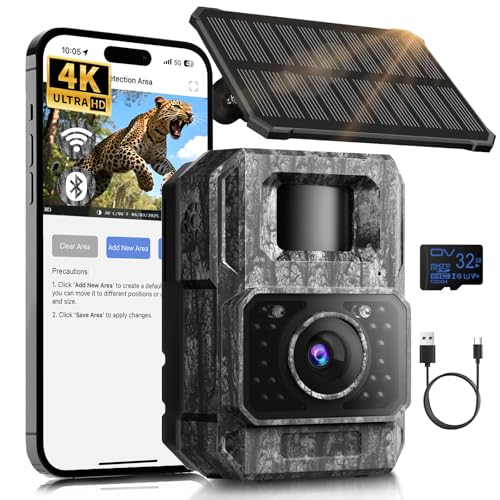
The MAXDONE model features a detachable solar panel, a 6000mAh rechargeable battery, and multiple charging options including solar and USB-C. It supports WiFi and Bluetooth through the TrailCamGO app, with a stated 55-foot connection range. The device delivers 4K video and 64MP photos, with an emphasis on extended field operation powered by solar energy, ideal for remote monitoring and long deployments.
Moultrie Edge 2 Cellular Trail Camera

The Moultrie Edge 2 provides nationwide 4G LTE coverage with Auto Connect, eliminating manual SIM management. It captures 36MP photos and 1080p video with HD audio, delivering clear day and night footage. The device emphasizes ease of use for scouting across large areas, backed by USA-based support. A practical choice for users who want broad cellular coverage without complex network setup.
Buying Guide: Key Purchase Considerations
- Connectivity needs: Cellular (4G/5G) cameras provide remote access and live feeds, but require data plans or trial offers. Non-cellular models rely on local SD cards and Wi-Fi (where available).
- Photo and video quality: Beginners often benefit from higher megapixels and 1080p or 4K video, balanced with storage capacity and battery life considerations.
- Trigger speed and detection range: Faster triggers capture more wildlife, while longer detection ranges cover broader terrain. Consider 0.2s to 0.5s triggers as a baseline for active areas.
- Night vision: No-glow infrared helps minimize disturbance to animals and improves stealth in the field.
- Durability and weather resistance: IP ratings (IP66/IP65) indicate weatherproofing for rain, dust, and cold conditions; choose accordingly for outdoor setups.
- Power options: Battery power is simple but may require frequent changes; solar panels extend runtime, particularly in remote locations.
- App experience: A user-friendly companion app reduces setup complexity, lets you preview media, and simplifies firmware updates.
- Support and warranties: Brands with responsive customer support and clear warranty terms improve peace of mind for first-time buyers.
Comparative Considerations
- Ease of use: For beginners, cameras with built-in SIM and straightforward apps reduce learning curves, as seen with several cellular models.
- Field deployment: Compact, camouflaged designs are easier to conceal and protect from theft, which is a practical factor for outdoor setups.
- Cost of ownership: Cellular plans add ongoing costs; many models offer trial data or free basic transmission plans, which is a key factor in total cost over time.
- Local vs remote viewing: If quick on-site checks are common, WiFi-enabled models or those with direct app previews can save time; for distant locations, cellular connectivity matters more.