For photographers who want to push their smartphone cameras beyond standard zoom, a high-quality telephoto lens can dramatically improve distance shots, detail, and creative framing. This guide highlights five versatile telephoto lenses that pair with most smartphones, offering features such as high magnification, additional lens elements, and convenient accessories like tripods or monocular use. Each option is evaluated based on optics, build, and real-world versatility to help you choose the right kit for everyday travel, wildlife, or night sky photography.
Summary of selected products:
| Product | Brand | Key Benefit | Notes |
|---|---|---|---|
| Phone Camera Lens Kit 28X Telephoto Lens | BNIFI | Long-distance captures with focus control | Monocular use possible; case removal recommended |
| Phone Camera Lens Kit Upgraded 28X Wide 0.6X Macro 20X Fisheye | BNIFI | 4-in-1 set for creative flexibility | Fisheye at 198°; tripod advised |
| 36X Telephoto Lens with Tripod | Evil eye | High magnification with sturdy build | Includes tripod; versatile outdoor use |
| SV105 Telescope Camera | SVBONY | Beginner-friendly astrophotography | USB/digital capture; quick setup |
| 32X Phone Camera Lens Telephoto | MoYinG | High power with dual purpose | Phone clip included; compatible with iPhone/Android |
BNIFI 28X Telephoto Lens for Smartphones

The BNIFI 28X Telephoto Lens is designed to extend a phone’s reach while preserving image quality. It offers a 28x magnification with a focus ring, enabling precise sharpness adjustments for distant subjects. A key feature is its dual-use capability: it can function as a monocular telescope in handheld mode, adding flexibility for travelers and outdoor enthusiasts. To optimize results, users may need to remove the phone case for the sharpest alignment. The kit typically includes an E-clip mounting system and accessories suitable for most smartphones.
BNIFI 28X Telephoto Wide Kit Plus Macro and Fisheye

This upgraded BNIFI set combines four lenses in one package: a 28x telephoto, 0.6x wide-angle, 20x macro, and a 198° fisheye lens. The configuration is intended to turn an ordinary phone into a capable photographic tool for distant scenes, close-ups, and expansive creative shots. The design emphasizes optical clarity while acknowledging typical smartphone limitations, and a tripod is recommended for stable telephoto results, especially in low-light or distant scenes.
36X Telephoto Lens with Tripod
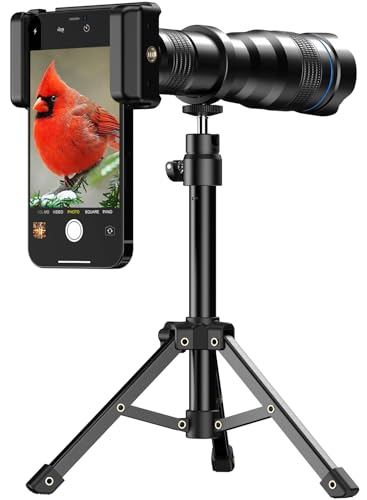
The Evil Eye 36X Telephoto Lens offers a high degree of magnification with a robust aluminum build. The focus ring enables precise distance adjustments, turning a smartphone into a long-range imaging tool suitable for landscapes, wildlife, and events. The kit includes a tripod for stability, addressing common handheld shake issues at high magnification. Its design aims to minimize edge drop-off and maintain image clarity across the frame, making it suitable for outdoor enthusiasts and travel photographers.
SVBONY SV105 Telescope Camera
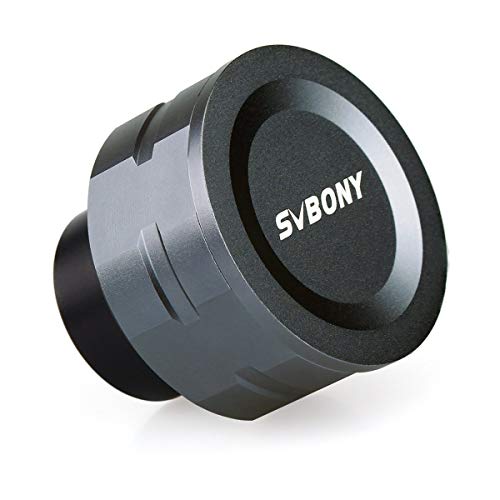
SVBONY SV105 serves as an entry point for astrophotography with a 1.25″ IMX307 CMOS sensor and an electronic eyepiece. It is designed for lunar and planetary imaging, offering Windows-compatible software such as Sharpcap Capture for real-time capture and video. The device supports plug-and-play operation with no driver requirements and enables quick transfer of live telescope views to a PC, ideal for beginners who want to explore astrophotography without complex setup.
MoYinG 32X Telephoto Lens for Smartphones

The 32x MoYinG telephoto lens emphasizes high-power magnification with an anti-shake design to improve image clarity at distance. It is described as a dual-purpose device: when attached to a phone, it acts as a telephoto lens, and when held as a handheld monocular, it serves as a portable telescope. It includes a phone clip for secure mounting and is compatible with both iPhone and Android devices, offering flexibility for diverse mobile ecosystems and traveler use.
Buying Guide: Key Purchase Considerations
Magnification and optical quality: Higher magnification can reveal distant subjects, but it may amplify shake and reduce brightness. Look for lenses with stable optics, good coating, and a clear center with minimal edge distortion.
Mounting compatibility: Check the mounting system (clip-on, universal clip, or dedicated phone case) and confirm compatibility with your phone model. A removable case often helps achieve better alignment and sharpness.
Accessories and stability: Tripods and mounts support sharpness at long distances. A stable tripod or monopod helps when using high-magnification lenses, especially in wind or outdoor settings.
Versatility: Some kits combine multiple lenses (telephoto, wide-angle, macro, fisheye) for flexible shooting. Consider whether you want a single-purpose telephoto or an all-in-one kit for travel and experiments.
Build quality and durability: Aluminum bodies and solid mounting hardware tend to last longer and resist wear in varying weather. Look for lenses that feel sturdy and include protective caps or pouches.
Software and compatibility: If a lens requires companion apps for image capture, ensure the app is available for your device’s OS and supports your workflow (RAW capture, video, or lens correction).
How to Choose the Right Telephoto Lens for Your Smartphone
Start by defining your main use: wildlife, sports, travel, or night sky. For daytime wildlife or distant landscapes, prioritize higher magnification with stable mounting. For street photography or moments where you move quickly, a lighter, more portable option with good optical quality may be preferable. If you plan to capture the Moon or planets, ensure your lens works well in low-light scenarios and consider adding a monocular use mode for quick observation without attaching to a phone.
Usage Scenarios and Practical Tips
Travel and sightseeing: A compact telephoto set with 28x to 32x magnification and a small tripod makes distant buildings and landscapes appear closer. Always carry a lightweight tripod or clamp to minimize shake on high magnification.
Bird watching and wildlife: Telephoto performance is key, but stability matters most. Use a telephoto lens with a stable clip and consider a small, portable tripod for steady shots at distance.
Astronomy for beginners: An electronic eyepiece or dedicated telescope camera can help beginners capture the Moon or bright planets. Software like Sharpcap Capture or compatible apps simplify real-time viewing and recording.