Finding the right motion activated wildlife camera depends on triggering speed, image quality, battery life, and ease of use in the field. This guide highlights five dependable options, balanced for rugged outdoor use and reliable wildlife monitoring. Each pick is evaluated by what matters most to outdoor enthusiasts: fast trigger times, clear night vision, durable housings, and straightforward setup. Use the quick summary table below to compare core specs at a glance.
| Product | Camera Type | Resolution | Trigger Time | Key Benefit |
|---|---|---|---|---|
| DEATTI Trail Camera | Trail Camera | 48MP / 4K | 0.1s | Self-contained hotspot wi-fi access |
| GardePro E6 | Trail Camera | 48MP / 1296P | Fast trigger | Reliable Wi‑Fi with antenna |
| GardePro E5S | Trail Camera | 64MP / 1296P | Fast trigger | High-end night vision |
| Meidase P70 | Trail Camera | 64MP / 1296P | 0.1s | Strong low-light performance |
| KJK Trail Camera | Trail Camera | 36MP / 2.7K | 0.1s | Compact with 130° view |
These cameras share common strengths for wildlife monitoring in the United States: robust waterproofing, reliable motion sensing, and the ability to share or review footage remotely. The following sections break down five models that best align with the “motion activated wildlife camera” use case, helping you choose for security, wildlife observation, or research applications.
DEATTI Trail Camera: 48MP 4K With 0.1s Trigger

The DEATTI Trail Camera combines high-resolution stills and 4K video with a compact, weatherproof design. It supports a built-in WiFi/Bluetooth connection for remote monitoring and management via a mobile app, enabling quick checks from a distance. The camera includes a 32GB SD card and eight batteries to support extended field use. Its 0.1-second trigger time helps capture fast wildlife movements with minimal blur, while night vision supports nocturnal activity surveillance. The device acts as its own hotspot, not a home Wi‑Fi client, which can simplify field setups in remote locations.
Key features include 2160P video, 48MP stills, and a weatherproof shell for outdoor environments. The device’s hotspot approach means users won’t rely on nearby networks, but it requires proximity (5–8 meters) for optimal mobile connection. The model is suitable for wildlife researchers, wildlife photography enthusiasts, and property owners who want immediate, real-time footage without tying into a home network.
GardePro E6 Trail Camera: 48MP With No Glow Night Vision

The GardePro E6 emphasizes connectivity and reliability, featuring low-power Wi‑Fi and Bluetooth with a free GardePro Mobile app. It includes an external antenna to improve signal strength, reducing disconnections while transmitting media. The 48MP stills and 1296P video deliver crisp results, with a wide 110-degree field of view for broad coverage. The camera’s encoding—H.264—helps with efficient video playback and sharing. This model suits users who prioritize seamless app-based control and steady wireless transfer to a smartphone for quick scouting and documentation.
GardePro E5S Trail Camera: 64MP, 1296P HD

The E5S model elevates image quality with 64MP captures and 1296P HD video, paired with advanced night vision capabilities. Its nocturnal performance is supported by high-contrast imaging and adaptive infrared illumination. The camera is built for rugged outdoor use and provides fast motion-triggering (noted at 0.1 seconds) and a rapid recovery time, supporting continuous monitoring during high-activity periods. With waterproof construction, this option is well-suited for wildlife surveillance on larger properties or research sites where nocturnal activity is critical.
Meidase P70 Trail Camera: 64MP, 1296P, No-Glow IR

The Meidase P70 delivers high-resolution 64MP imagery and 1296P video with No-Glow IR illumination, designed to minimize disturbance to wildlife. Its 0.1-second trigger captures fast movements, complemented by effective motion sensing and a durable waterproof housing. The camera is suitable for nocturnal wildlife studies, property monitoring, and hunting contexts where discreet nighttime footage is essential. This model’s combination of sharp daytime images and stealthy night footage makes it a strong all-around choice for serious wildlife observers.
KJK Trail Camera: 36MP, 2.7K With 0.1s Trigger
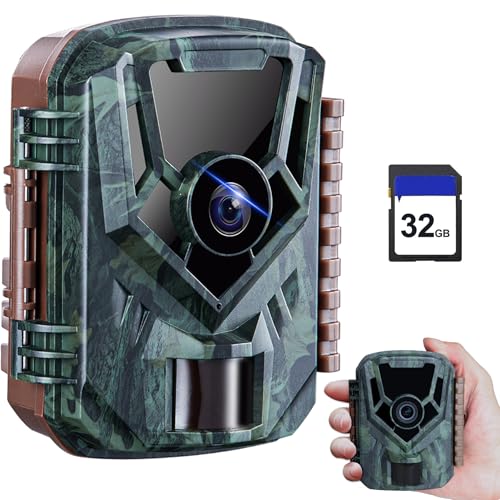
The KJK model emphasizes a compact form factor without sacrificing performance. It captures 36MP stills and 2.7K video, with a wide 130-degree field of view and a 0.1-second trigger. Its 2.0-inch HD TFT screen aids in quick on-site review, while the no-glow infrared LEDs help maintain stealth in low-light conditions. This camera is particularly suitable for backpacking, small-property surveillance, or educational projects where size and ease of use matter as much as image quality.
WOSPORTS Mini Trail Camera: 32MP, 1080P, Card Reader

The WOSPORTS mini camera balances portability with practical features. It includes a card reader for quick data access, which is handy during fieldwork or quick field data collection. The IP66 waterproof rating supports use in challenging weather, and its night vision with motion activation helps document wildlife activity around the clock. Powered by standard AA batteries, it offers a compact option for researchers or outdoor enthusiasts seeking a light, unobtrusive setup for monitoring small- to mid-sized wildlife.
Buying Guide: Key Purchase Considerations
When selecting a motion activated wildlife camera, consider trigger speed, image and video quality, night vision, power options, and network connectivity. A few questions can help narrow the field:
- What will you monitor and in what conditions? For dense forests, a camera with strong night vision and a wide angle helps reduce blind spots.
- Do you need remote access? Wi-Fi or Bluetooth can simplify checking footage, but some models operate as their own hotspot, requiring proximity to connect.
- How will you power the camera? Systems with solar charging or long-life batteries reduce maintenance, especially in remote locations.
- What level of image quality is required? 48MP stills and 1296P video deliver crisp daytime footage, while no-glow IR helps nighttime documentation without startling wildlife.
- Durability and weather resistance matter for long-term outdoor deployment. Look for IP ratings and rugged housings.
Comparative Perspectives
For researchers prioritizing field efficiency and easy media transfer, models with app-based management and reliable wireless links offer tangible time savings. If you prefer independence from cellular networks or services, cameras designed to operate as hotspots provide autonomous operation. In crowded or high-activity sites, ultra-fast trigger speeds (0.1s) minimize missed captures, while robust night vision supports nocturnal behavior studies. Budget considerations often balance upfront hardware with ongoing maintenance (batteries, memory cards) and ease of data retrieval.
Picking By Scenario
Property security often benefits from models with longer standby battery life and rapid 0.1s triggers, enabling quick alerts upon movement. Wildlife researchers in remote habitats may favor no-glow IR and rugged IP66-rated housings for durability. For casual wildlife observation, a compact camera with a mobile app and straightforward setup can be enough to document visits without heavy technical overhead. Consider combining two or more devices if you need coverage across different habitats or times of day.