Discover top motion activated trail cameras trusted by outdoor enthusiasts and homeowners across the United States. This guide highlights five high-performance models that excel in night vision, trigger speed, battery options, and durability. Each option is evaluated for remote access, image quality, and field reliability to help you choose the right camera for deer monitoring, security, or nature observation. Use the quick summary below to compare key features at a glance.
| Product | Resolution / Video | Trigger Speed | Night Vision | Waterproof Rating |
|---|---|---|---|---|
| DEATTI Trail Camera | 48MP / 4K | 0.1s | Night Vision | IP66 |
| GardePro E6 | 48MP / 1296p | Noted fast trigger | No Glow Night Vision | Weatherproof |
| MAXDONE Trail Camera | 64MP / 4K (implied) | Fast trigger | Night Vision | IP66 |
| GardePro A3S (2-Pack) | 64MP / 1296p | 0.1s | No Glow Night Vision | Waterproof |
| TKENPRO Trail Camera | 2K | 0.2s | Night Vision | IP66 |
TOP PICK: If you want a blend of high resolution, rapid trigger speed, and app-based remote control, consider models from DEATTI, GardePro, MAXDONE, and TKENPRO. For security-focused users who value long-range night vision and robust weather sealing, the GardePro and MAXDONE lines offer compelling features. The table above provides a quick snapshot to support your buying decision before you dive into in-depth product details.
DEATTI Trail Camera 48MP 4K With Wifi And Bluetooth

The DEATTI camera delivers 2160P 48MP stills and 4K video, designed for wildlife monitoring in low light. It includes built-in WiFi and Bluetooth to enable remote access via a mobile app. The device acts as its own hotspot, requiring proximity of 5-8 meters for connections, and it ships with a 32GB SD card and eight batteries for extended field use. Its waterproof construction supports outdoor deployment in various weather conditions, making it suitable for deer trails, wildlife plots, and property surveillance. The model emphasizes quick responsiveness with a 0.1s trigger time, helping capture fast-moving animals.
What to know: This camera creates its own hotspot rather than connecting to home Wi-Fi. Users seeking cloud-like remote viewing should plan for direct smartphone access within hotspot range. The built-in display aids quick checks on the device’s status and captured media, while the high-resolution images provide sharp evidence for wildlife researchers and outdoor enthusiasts alike.
GardePro E6 Trail Camera WiFi 48MP 1296P

The E6 model emphasizes robust wireless connectivity with a dedicated app (GardePro Mobile). It features a low-power Wi-Fi and a strong antenna, reducing disconnections and enabling faster picture and video transfers. The camera captures 48MP stills and 1296p HD videos with a wide 110° field of view. This combination supports reliable scouting, wildlife monitoring, and property security. The no-glow night vision helps maintain stealth during nocturnal observations, while the weatherproof design supports outdoor use in varied environments.
Considerations: Users should stay within the signal range to maximize performance and minimize delays. The absence of cloud-based features is offset by a straightforward app experience and reliable local storage. The wide-angle lens helps cover more ground per trigger, which is valuable for field scouts and homestead surveillance alike.
MAXDONE Trail Camera 4K 64MP With Solar Power
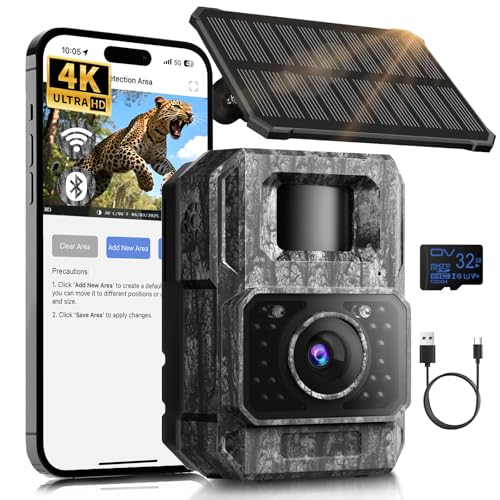
MAXDONE pairs 64MP image capture with 4K video, offering a powerful feature set for long-term outdoor use. A detachable solar panel and a large 6000mAh rechargeable battery support extended field operation without frequent battery changes. The camera uses WiFi and Bluetooth for direct smartphone transfers via the TrailCamGO app, with a typical hotspot connection. Its IP66 rating provides strong protection against rain and dust, while the 130° wide-angle lens helps broaden monitoring coverage. This model is well-suited for remote locations, wildlife plots, and security perimeters where access to regular power is limited.
Practical notes: Solar charging improves uptime in sunny locations, but users should verify sun exposure and panel orientation. The app facilitates quick media sharing so you can inspect activity without removing the SD card. The built-in hotspot setup means you’ll manage the camera through a local network, which is ideal for areas with unreliable cellular coverage.
GardePro A3S Trail Camera 2 Pack

This two-pack offers 64MP images and 1296p HD video with 100ft night vision. The A3S features Sony Starvis sensors and no-glow infrared LEDs for stealth in low-light conditions. Its fast 0.1s trigger speed and 100ft night capability enable precise wildlife capture while minimizing disturbance. The set includes two cameras, expanding monitoring coverage for larger outdoor areas—great for perimeter security, long field plots, or comprehensive trail surveillance. The cameras also support H.264 video encoding for efficient storage and broad compatibility.
Deployment tips: Use this kit for multi-site monitoring where consistent night performance matters. The dual-camera option simplifies area coverage around cabins, feeders, and game trails. Battery life and memory capacity should be tracked, especially in remote sites where maintenance visits are infrequent.
TKENPRO Trail Camera 2G Cellular 4G

TKENPRO combines 2K live feed with built-in SIM card support and a data plan, enabling cellular remote viewing and control. The model emphasizes a 0.2s trigger speed and strong no-glow night vision, making it suitable for security-sensitive sites and wildlife observation. The IP66 rating ensures weather resistance, supporting outdoor use in rain, dust, and cold. A dedicated app allows live monitoring, media downloads, and alerts, making it a practical choice for remote properties, campsites, and hunting leases. Note that cellular plans are separate from the device and subscription terms apply.
Key considerations: Cellular connectivity can offer real-time updates but requires ongoing data plans. Users should evaluate signal availability at deployment sites and consider backup power options for continuity during trips away from maintenance.
Buying Guide: How To Choose The Right Motion Activated Trail Camera
- Trigger speed and recovery time: For fast-moving wildlife, aim for cameras with trigger times of 0.1–0.2 seconds and short recovery times to prevent missed shots.
- Resolution and video quality: Higher still-image resolution (e.g., 48MP, 64MP) and 1080p–1296p video provide clearer evidence, useful for identification and research.
- Night vision and stealth: No-glow LEDs reduce disturbance to animals and improve nocturnal footage, especially in security-sensitive areas.
- Connectivity options: WiFi and Bluetooth enable easy local access; cellular models add remote viewing but require data plans and coverage checks.
- Power and endurance: Battery capacity and solar charging options extend field time. Look for models with long battery life and energy-saving modes.
- Weather resistance: IP ratings (IP66 or higher) protect cameras in rain, dust, and cold conditions. Consider placement and mounting to maximize protection.
- Storage and media management: Large memory cards support longer monitoring periods; check support for H.264/MP4 formats for broad compatibility.
- Mounting flexibility: Wide-angle lenses (e.g., 110–130°) capture broader scenes, which is beneficial for perimeter surveillance and field plots.
- Software ecosystem: Mobile apps offering live view, instant alerts, and simple media retrieval can reduce on-site visits and improve decision speed.
- Budget and value: Compare upfront costs against long-term maintenance needs, battery replacements, and data plans if using cellular models.
Across these options, a balance of image fidelity, reliable night vision, and robust weather resistance provides comprehensive coverage for wildlife observation and property security. Consider deployment context—remote plots, frequent wildlife activity, or security perimeters—to determine whether a hotspot WiFi, a dedicated solar setup, or a cellular connection best suits your goals. Always verify coverage and permissions for wildlife monitoring in your region before installation.