The following selections highlight top global shutter CMOS cameras ideal for machine vision, robotics, streaming, and high-speed captures. Each option minimizes rolling artifacts and provides crisp, distortion-free images even when objects move rapidly. The list focuses on compact modules and USB webcams that are widely compatible with PCs, laptops, and single-board computers. Use the Buying Guide below to compare lenses, frame rates, and sensor specs to find the best fit for your application.
| Product | Brand | Resolution / Frame Rate | Key Benefit |
|---|---|---|---|
| ELP Global Shutter USB Camera – Wide Angle | ELP | 2MP, 1920×1200, up to 90fps | 120° wide, low distortion lens |
| ELP Global Shutter USB Webcam – 1080P 90fps | ELP | 1080P, 90fps | 5–50mm zoom, manual focus |
| MMlove USB Stereo Camera Module – 1200P 60fps | MMlove | 1200P@60, dual synchronized lenses | Synchronous dual lens for stereo |
| SVPRO 2MP Global Shutter USB Camera | SVPRO | 1200P@60fps | Dual M12 lenses, 85° view |
| innomaker GS Camera Module for Raspberry Pi | innomaker | 1.58MP @ 60fps | Pi compatibility, external trigger |
Below are concise descriptions of each product, focusing on the features most relevant to high-speed imaging and global shutter performance.
ELP Global Shutter USB Camera – Wide Angle

Global Shutter: Captures fast-moving objects with crisp, artifact-free images. Avoids rolling shutter distortions to deliver a more accurate full picture. HD resolution is 2MP at 1920×1200 with MJPEG up to 90fps. Uses a 1/2.6” AR0234 sensor for sharp images and offers a wide 120-degree distortion-free lens. The compact 38mm x 38mm board is designed for installation in tight spaces, enabling applications in robotics, inspection, or embedded video systems.
ELP Global Shutter USB Webcam – 1080P 90fps

Global Shutter efficiency supports high-speed scenes without rolling artifacts. Offers 2MP resolution at 1920×1200 with MJPEG up to 90fps. Features a 5–50mm varifocal lens, enabling flexible focus and exposure control for varying distances. Ideal for professional conferencing, live streaming, or microscopy where rapid subject movement is common. The adjustable zoom and focus help tailor the field of view to the task at hand.
MMlove USB Stereo Camera Module – 1200P 60fps

Dual synchronized lenses provide stereo imaging with global shutter, reducing distortion in fast-moving scenes. The module delivers 1200P at 60fps and up to 600p at 120fps, suitable for immersive VR, gesture recognition, or 3D scanning. The 112° wide angle enhances spatial perception, and the synchronous output supports advanced vision tasks like real-time depth sensing when paired with compatible software and hardware.
SVPRO 2MP Global Shutter USB Camera

This 2MP global shutter camera features two M12 lenses, enabling a 85-degree low-distortion viewing angle. It supports 1200P at 60fps and 720P at 60fps, with capabilities tailored for industrial and machine-vision applications. The dual-lens setup is ideal for synchronized stereo capture, object tracking, and precise measurement tasks in dynamic environments.
innomaker GS Camera Module for Raspberry Pi
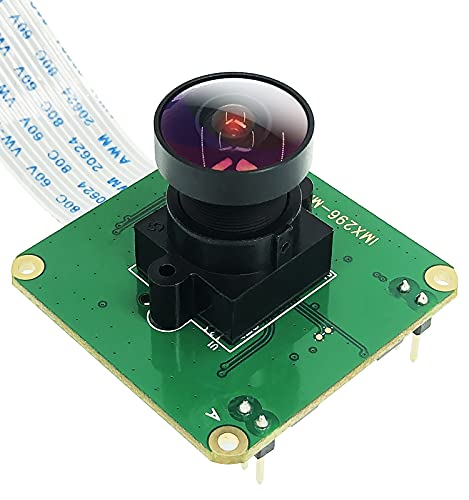
Designed for Raspberry Pi ecosystems, this global shutter camera uses the IMX296 mono sensor at 1.58MP with 60fps. It supports external triggering and is compatible with Pi 5/4/3/Zero, making it suitable for hobbyist projects, surveillance prototypes, or embedded vision experiments. The module’s 6.3mm sensor size and plug‑and‑play drivers simplify integration in compact builds and automation setups.
Buying Guide
Key considerations when choosing a global shutter CMOS camera:
- Sensor and resolution: Higher resolution improves detail, but may require more processing power. Global shutters are essential for fast motion without rolling artifacts.
- Frame rate: Choose a camera that supports the target frame rate at your desired resolution (e.g., 90fps at 1080p or 1200P at 60fps) to ensure smooth capture.
- Lens configuration: Fixed, varifocal, and dual-lens options affect field of view and depth perception. Wide angles can reduce distortion when paired with a good lens.
- Interface and compatibility: USB interfaces are widely supported by PCs and single-board computers. Confirm driver availability and software compatibility with your workflow (e.g., OpenCV, ROS, or custom pipelines).
- Mounting and form factor: Consider compact camera modules for embedded systems, robot headers, or machine-vision bays. Look for low-profile boards and 38–40mm footprints when space is constrained.
- Synchronization: Dual-lens or stereo configurations enable depth sensing or 3D reconstruction but may require precise timing between channels.
- Power and cabling: Ensure the power budget aligns with your system and that cables are length-sufficient for your setup.
- Software support: Look for camera modules with SDKs or example code for Raspberry Pi, Windows, or Linux, including streaming and image processing examples.
For selecting the best option, map your application needs to sensor performance, lens choice, and integration complexity. If fast action is central, prioritize higher frame rates and robust global shutter performance. If 3D or stereo vision is required, consider dual-lens models and synchronization features. For embedded projects, module size and Pi compatibility will guide your choice. Always verify compatibility with your preferred development stack and hardware platform before purchase.