Photographers and videographers increasingly rely on carbon fiber camera poles for lightweight, rugged support in diverse environments. This guide highlights five top options that blend low weight with high load capacity, quick setup, and flexible configurations. Each product blends carbon fiber construction with practical features for travel, studio, and outdoor shoots. Use the buying guide to compare height, head compatibility, and mounting options to find the ideal pole for your gear and shooting style.
| Product | Brand | Max Load | Max Height |
|---|---|---|---|
| NEEWER Upgraded 80.7″ Carbon Fiber Camera Tripod Monopod | NEEWER | 26.5 lb / 12 kg | 80.7″ / 205 cm |
| IFOOTAGE Carbon Fiber Camera Pole | IFOOTAGE | Not specified | 37-108 cm / 14.6-42.5 in |
| NEEWER 67.7″ Camera Monopod Stand | NEEWER | 13.2 lb | 67.7″ / 172 cm |
| K&F CONCEPT 60 inch Carbon Fiber Camera Tripod | K&F CONCEPT | 17 lb | 60″ / 152 cm |
| Manbily Carbon Fiber Camera Monopod | Manbily | 15.4 lb | 61″ / 155 cm |
NEEWER Upgraded 80.7″ Carbon Fiber Tripod Monopod

This carbon fiber travel tripod combines a sturdy 28 mm column with a significant maximum height of 80.7 inches (205 cm) and a load capacity of 26.5 lb (12 kg), providing reliable support for DSLR and video equipment. The dual-center-column design enables extended reach and inverted shooting for macro work. Quick-release twist locks simplify height adjustments, while an included carrying bag supports travel and on-the-go shoots. The center column features a hanging hook for counterbalance with sandbags (not included) to further stabilize equipment in windy or uneven conditions.
IFOOTAGE Carbon Fiber Camera Pole

Designed as a versatile extension tube, this carbon fiber pole extends from 37 cm to 108 cm (14.6 to 42.5 in) and accommodates 1/4″ and 3/8″ screws for compatibility with cameras, fluid heads, smartphones, and projectors. It is suitable as part of a tripod or monopod system, offering a lightweight solution for extending reach without adding excessive bulk. The product emphasizes compatible fasteners and flexible installation to support a wide range of imaging setups.
NEEWER 67.7″ Camera Monopod Stand

This lightweight carbon fiber monopod offers a maximum height of 67.7 inches and a detachable base for added versatility. The four-section telescopic center column provides strong extendability, while a 1/4″ mounting screw supports a range of cameras, camcorders, and gimbals. The detachable base allows the monopod to double as a compact stand, useful for stabilizing gear in dynamic shooting environments, such as weddings or field shoots.
K&F CONCEPT 60 Inch Carbon Fiber Tripod

This 60-inch carbon fiber tripod emphasizes high-end materials and portability. The 5-section legs and a 360-degree panoramic ball head enable smooth, precise positioning for landscape and portrait shoots. The included quick-release plate and detachable monopod add flexibility for on-the-move photography, while a low overall weight makes it suitable for travel. The head’s Arca-Swiss compatibility and 1/4″ screws support a wide range of cameras and accessories into a compact, reliable rig.
Manbily Carbon Fiber Monopod
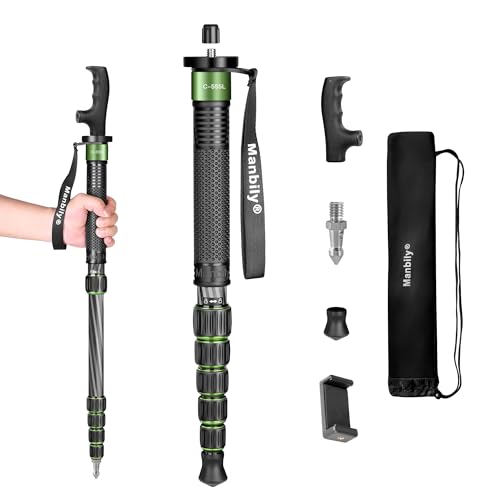
The Manbily monopod offers a compact solution at 61 inches with a robust 28 mm carbon fiber diameter, delivering weight support up to 15.4 lb. Its reinforced mounting platform uses riveted aluminum to secure the camera mount, combining strength with lightweight design. A reversible 1/4″ and 3/8″ screw top plate increases compatibility with a wide array of cameras and accessories, making it a versatile travel companion for photographers who require both height and stability in tight spaces.
Buying Guide: Key Purchase Considerations
When selecting a carbon fiber camera pole, consider several factors to balance performance with portability:
- Height and reach: Determine whether you need tall extensions for elevated shots or shorter poles for intimate angles and travel ease.
- Weight and portability: Lighter poles improve travel convenience, but ensure strength to support your gear at the desired height.
- Load capacity: Match the pole’s maximum load to your camera body, lens, and accessories to prevent sag or instability.
- Construction quality: Look for carbon fiber specifications (number of layers, diameter like 28 mm) and locking mechanisms that are smooth and secure.
- Head compatibility: Check for Arca-Swiss or other quick-release systems, and whether the head rotates 360 degrees for panoramic shooting.
- Modularity: Some models convert between tripod, monopod, and walking stick configurations; evaluate how this aligns with your workflow.
- Stability features: Center-column hooks for sandbags, anti-slip feet, and adaptable bases can improve stability in wind or uneven terrain.
- Accessory ecosystem: Consider screws, quick-release plates, and compatibility with your current camera lineup and accessories.
Comparison Perspectives
Travel-focused poles emphasize lightness and compact storage, often with detachable bases for quick conversion to a handheld or table-top setup. Professional configurations may prioritize maximum height and load capacity, with robust locking systems and improved stability features. For underwater or wet environments, look for corrosion resistance and waterproof carbon fiber components. Finally, compatibility with your existing gear, including gimbals and head systems, should guide the final choice to ensure a seamless shoot workflow.