Camera lens mount adapters expand your system by letting you reuse existing lenses on different bodies. This article highlights a curated selection of adapters compatible with Canon EF/EF-S and other popular mounts, emphasizing build quality, autofocus behavior, and signal integrity. Whether you shoot with Canon, Nikon, Sony, or EOS R series, these adapters offer practical ways to maximize your existing glass.
| Product | Brand | Compatibility | Notable Features |
|---|---|---|---|
| Canon Mount Adapter EF-EOS R | Canon | EF/EF-S lenses to EOS R family | Dust- and water-resistant; exterior matched to EF |
| Canon Mount Adapter EF – EOS R | Canon | EF/EF-S lenses to EOS R family | Built-in control ring; stylish EF-style design |
| EF-EOS M Lens Adapter | EBYPHAN | EF/EF-S lenses to Canon EOS-M | Inbuilt aperture motor; built-in IS |
| VILTROX EF-EOS M Adapter | VILTROX | EF/EF-S lenses to Canon EOS M | Wide lens compatibility; supports AF and IS |
| Fotodiox Nikon F to Canon EOS | Fotodiox | Nikon F lenses to Canon EOS EF/EF-S | All-metal construction; manual operation |
Canon Mount Adapter EF-EOS R

The Canon Mount Adapter EF-EOS R enables EF and EF-S lenses to be used with EOS RP, EOS R, EOS R6, and EOS R5 bodies. Its exterior design mirrors Canon’s EF line, maintaining a familiar tactile feel for users transitioning to mirrorless bodies. The adapter provides a dust- and water-resistant build, making it suitable for field use in varied conditions. This option preserves lens control and handling characteristics while expanding the EOS R ecosystem with a straightforward, reliable solution.
Canon Mount Adapter EF – EOS R, Compatible with EOS RP, EOS R, EOS R6, EOS R5

This standard mount adapter preserves EF/EF-S compatibility with Canon’s EOS R system, including EOS RP, R5, and R6. Its built-in control ring provides quick access to camera functions, which can speed up workflows, especially for video and stills. The exterior is designed to align with EF lenses, delivering a cohesive, familiar user experience for photographers upgrading to Canon’s mirrorless lineup.
EF-EOS M Lens Adapter Auto-Focus
The EF-EOS M Lens Adapter from EBYPHAN lets Canon EF and EF-S lenses work with Canon EOS-M bodies (M2, M3, M5, M6, M10, M50, M100, and related models). It features an inbuilt aperture motor and electronic contacts to pass shutter, aperture, and ISO data to the camera. A built-in image stabilizer helps keep shots sharp, and the user can control lens aperture directly from the camera. Note that camera settings may require configuring exposure modes to optimize performance with adapted lenses.
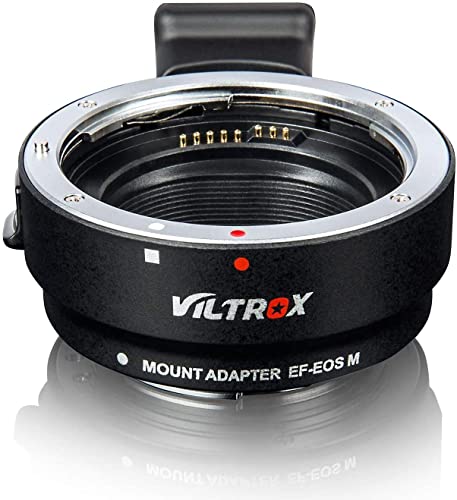
VILTROX EF-EOS M Lens Mount Auto Focus Adapter

The VILTROX EF-EOS M Adapter enables Canon EF/EF-S lenses to be used on Canon EOS M bodies (M100, M50, M3, M10, M6, M5). It supports autofocus and image stabilization functions of compatible lenses, expanding creative options for entry-level and enthusiast shooters. The adapter also includes a removable tripod mount, aiding stability when using heavier glass on smaller bodies. Users should verify AF behavior on specific lens-body combinations for best results.
Fotodiox Lens Mount Adapter Nikon F to Canon EOS

The Fotodiox Nikon F Mount D/SLR Lens to Canon EOS (EF, EF-S) Mount adapter is a manual adapter designed for use when autofocus and electronic aperture control are not required. It is built with high-tolerance, all-metal construction to maintain rigidity and precision. This adapter is ideal for photographers who want to repurpose an extensive Nikon F lens collection on Canon bodies without engaging electronic communication between camera and lens. Expect full manual control over exposure settings.
Lens Mount Adapter EF-EOS R for Canon EF/EF-S Lenses

This EF-EOS R adapter is designed to work with Canon EF and EF-S lenses on EOS R, RP, R3, R5, R6, R6 II, R7, R8, R10, R50, and R100 bodies. It provides built-in IS stabilization and signal transmission via gold-plated contacts for reliable aperture control and communication. The adapter aims to maintain lens performance while offering a straightforward path to mirrorless flexibility across Canon’s RF-era cameras.
Buying Guide: Key Purchase Considerations
- Compatibility: Confirm which camera bodies and lenses you own. Some adapters are brand-specific (Canon-to-Canon), while others support third-party mounts (Nikon F, EF-S to EF, etc.).
- Autofocus and Metering: Not all adapters preserve autofocus or electronic metering. If you rely on AF or aperture control, prioritize adapters with built-in AF motors or electronic contacts.
- Image Stabilization: Some adapters include image stabilization or communicate IS data to the camera. If you shoot handheld, this can be valuable, especially with older or heavier lenses.
- Build and Durability: Look for dust- and weather-sealing, as well as solid physical construction. All-metal builds tend to last longer under field use.
- Size and Balance: Adapters add weight and length to the lens. Consider the impact on handling, especially with longer telephotos or fast primes.
- Control Ring and Customization: Some adapters add convenient control rings or configurable dials for quick access to exposure, ISO, or other settings—useful for video work.
- Cost vs. Benefit: If you own multiple lenses across different mounts, an adapter with AF and IS support might offer better long-term value than a purely manual option.
- User Experience: Reviews and user feedback reveal practical differences in AF speed, focus accuracy, and firmware compatibility across camera models.
- Future-Proofing: If you anticipate expanding your kit, choose adapters known for reliable updates and compatibility with newer camera bodies.