Finding the right 70-200mm telephoto lens can boost sports, wildlife, portrait, and event photography. This guide reviews top options across Canon, Sony, Nikon, Panasonic, and Sigma to help you choose a versatile f/2.8 or near-constant aperture lens with strong stabilization and build quality. Each pick balances image sharpness, autofocus performance, and field capabilities for both full-frame and mirrorless systems.
| Brand | Model | Key Feature | Mount Type |
|---|---|---|---|
| Canon | RF 70-200mm f/2.8 L IS USM | Bright f/2.8, 5-stop IS | RF |
| Sony | FE 70-200mm f/2.8 GM OSS II | High resolution, fast AF, Movie-friendly | FE |
| Nikon | NIKKOR Z 70-200mm f/2.8 S | Professional AF control, versatile for Z | Z |
| Panasonic | LUMIX S PRO 70-200mm f/2.8 | Dust/Freeze-resistant, robust build | L-Mount |
| Sigma | 70-200mm f/2.8 DG DN OS for Sony | OS stabilization, versatile for Sony E | FE |
Note: The following sections highlight five representative lenses from the provided catalog. Each entry includes a direct link to its Amazon listing, a product image, and key features to aid quick comparison.
Canon RF 70-200mm F2.8 L IS USM Lens

Canon’s RF 70-200mm f/2.8 L IS USM delivers a bright, versatile telephoto zoom ideal for sports, wildlife, and events. The lens pairs a fast constant f/2.8 aperture with optical image stabilization up to 5 stops, helping capture sharp images in varied lighting. It is designed to be compact for a professional L-series telephoto, making it a strong choice for EOS R series shooters who demand high image quality and reliable autofocus across the zoom range.
Canon RF 70-200mm F4 L IS USM Lens

Canon’s RF 70-200mm f/4 L IS USM is the lighter, more compact option in the 70-200 family. It maintains strong image quality with a constant f/4 aperture and built-in image stabilization offering up to 5 stops. This lens is well-suited for travel and everyday use on EOS R mirrorless bodies, delivering reliable performance with a smaller footprint.
Sony FE 70-200mm F2.8 GM OSS II
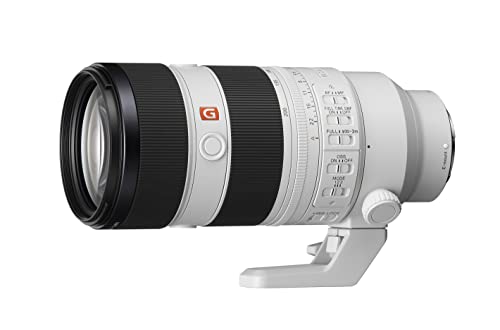
Sony’s FE 70-200mm F2.8 GM OSS II is built for high-resolution performance with two aspherical elements and ED/Super ED glasses to reduce chromatic aberration. It includes Sony’s Nano AR Coating II to minimize flare and ghosts. The lens supports quick AF with XD Linear Motors, making it adept for both stills and moving subjects. It’s compatible with 1.4x and 2x teleconverters for additional reach.
Sony FE 70-200mm F2.8 GM OSS

Sony’s flagship 70-200mm in the GM line emphasizes sharpness and clinically smooth bokeh. The constant f/2.8 aperture ensures consistent exposure and depth of field. Features include a Dual floating focus system for speed and precision, Nano AR coatings, and a dedicated zoom/iris control setup designed for cinematic use, with reduced focus breathing for video work.
Sigma 70-200mm F2.8 DG DN OS for Sony

Sigma’s 70-200mm F2.8 DG DN OS for Sony E-mount offers an attractive balance of performance and value. It provides Optical Stabilization and a robust build suitable for Sony mirrorless bodies. The high-speed AF motor and OS performance make it versatile for events, weddings, and sports where reliable tracking matters across the zoom range.
Buying Guide: Key Purchase Considerations
Compatibility and System Integration
Choose a lens that matches your camera system (Canon RF, Sony E, Nikon Z, Panasonic L-Mount, etc.). Consider whether you shoot primarily on a full-frame or APS-C body and whether you need dual image stabilization with your camera’s IBIS.
Aperture and Low-Light Performance
Constant f/2.8 offers consistent exposure and shallow depth of field across the zoom range, advantageous for portraits and events. Lighter f/4 options tend to be more compact and affordable but may require brighter lighting or higher ISO in dim settings.
Autofocus Speed and Accuracy
Sports and wildlife demand fast, reliable AF with tracking. Lenses in the GM, L, and equivalent expert lines generally provide superior AF performance and subject tracking across focal lengths.
Image Stabilization and Handling
Look for lenses with built-in optical stabilization (often up to 5 stops) or compatibility with body IBIS for sharper handheld shots, especially at slower shutter speeds.
Weight, Size, and Budget
Pro-grade 70-200mm lenses can be heavy and expensive. If you travel frequently or shoot portraits more than sports, a lighter f/4 option may offer a practical balance. Consider your travel, field work, and workflow when evaluating weight and cost.
Build Quality and Weather Sealing
Weather sealing and robust construction are important for outdoor workflows. If you work in challenging environments, a dust and splash-resistant design is a strong plus.
Future-Proofing and Expandability
Some lenses accept teleconverters for extended reach. Assess whether you want to preserve autofocus performance when using 1.4x or 2x extenders, and confirm compatibility with your camera system.